
What can I do if a co-owner is making unfinished repairs or not paying utilities and the property is losing value? – North Carolina
Short Answer
In North Carolina, a co-owner generally cannot unilaterally lock other co-owners out or let a jointly owned home deteriorate without consequences. Common options include (1) filing a partition action in Superior Court to force a division or sale, (2) asking the court to address access and preservation issues during the case, and (3) pursuing an accounting or reimbursement issues tied to possession, repairs, and property expenses. The best path usually turns on whether there has been an “ouster” (wrongful exclusion) and whether the work is necessary repair versus optional improvement.
Understanding the Problem
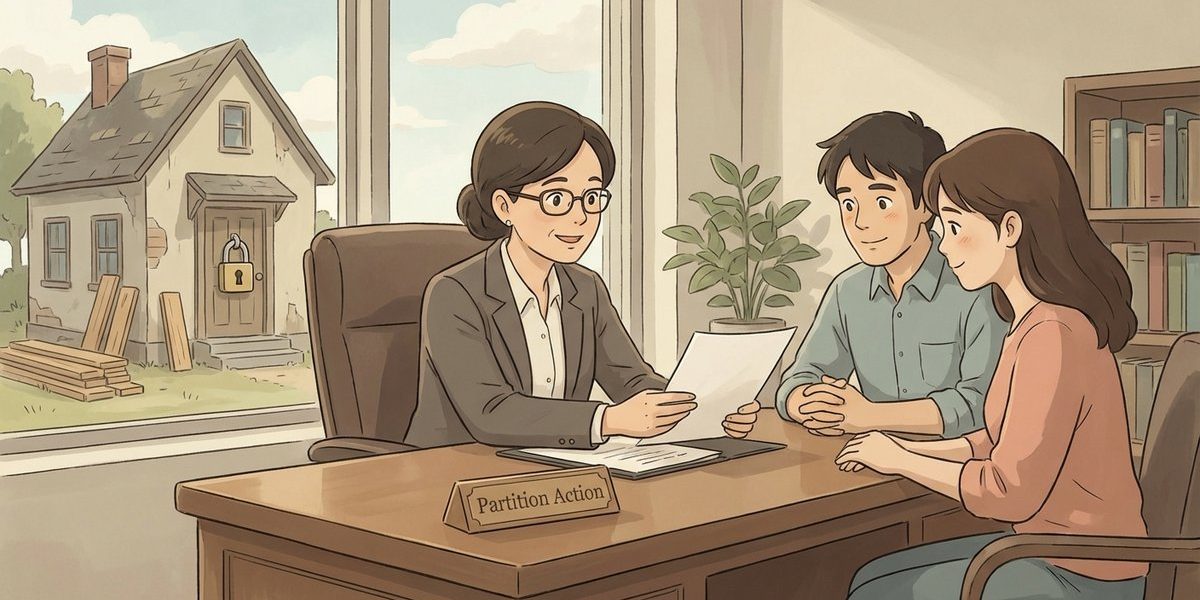
In North Carolina, what can be done when multiple family members co-own a home after a parent’s death, but one co-owner takes control of the property, changes the locks, blocks access, and starts renovations that are left unfinished while utilities go unpaid and the home appears to be losing value? The decision point is whether the situation should be handled through a partition case (to end the co-ownership through division or sale) and related claims about access, expenses, and property preservation.
Apply the Law
North Carolina partition law allows a co-owner to ask the Superior Court to partition the property—either by physically dividing it (rare for a single house) or by ordering a sale and dividing the proceeds. Separately, North Carolina law recognizes that each cotenant has a right to enter and use the property, and it provides tools when one cotenant actually excludes another (an “ouster”). North Carolina also has rules about when a cotenant can seek reimbursement for necessary repairs, taxes, and certain loan-related payments, and when reimbursement may be limited because the paying cotenant had exclusive possession.
Key Requirements
- Co-ownership interest: The person seeking relief must have an ownership interest (for example, as a tenant in common) even if the exact shares are disputed.
- Right to possession and access: Each cotenant generally has the right to enter and use the property, and lockouts can support an “ouster” claim and court intervention.
- Proper remedy (partition vs. access/accounting): A partition action can end the co-ownership through actual partition or a court-ordered sale; reimbursement/accounting issues may be addressed alongside or in related claims depending on the issue.
What the Statutes Say
- N.C. Gen. Stat. § 46A-26 (Methods of partition) – Authorizes the court to order actual partition, a partition sale, or a mixed approach, and it generally cannot force a cotenant to remain in co-ownership over objection.
- N.C. Gen. Stat. § 46A-75 (Sale in lieu of actual partition) – Allows a sale if actual partition would cause “substantial injury,” with the party seeking sale carrying the burden of proof.
- N.C. Gen. Stat. § 41-83 (Possession of property held as cotenants) – States that each cotenant has a right to enter and occupy the property, and addresses the concept of “ouster.”
- N.C. Gen. Stat. § 41-88 (Actual ouster; action to compel admission) – Allows an action to compel admission into possession when a cotenant claims actual ouster.
- N.C. Gen. Stat. § 41-86 (Reimbursement of a cotenant) – Addresses when a cotenant can seek contribution for necessary repairs, improvements, taxes, and certain interest payments, including limits tied to exclusive possession.
- N.C. Gen. Stat. § 41-85 (Rents and profits; accounting) – Provides for proportional sharing of rents/profits received from third parties and an accounting action when one cotenant receives more than their share.
Analysis
Apply the Rule to the Facts: The facts describe multiple family members who appear to co-own a home, with one co-owner living there, changing the locks, and refusing access. That fact pattern fits the “access/possession” problem addressed by North Carolina’s cotenancy statutes and may support an ouster-based request to be admitted back into possession. The abandoned renovations and unpaid utilities raise a “property preservation” problem that often becomes the practical reason to file a partition action so the court can move the case toward a sale (or other resolution) before the property loses more value.
Process & Timing
- Who files: Any cotenant. Where: Superior Court in the county where the real property is located in North Carolina. What: A partition petition requesting the court choose a method of partition (often a sale for a single-family residence) and address related issues needed to carry out the partition. When: As soon as it becomes clear the property is being blocked from access or is deteriorating; delays can make valuation and condition disputes harder to prove.
- Early case steps: The court addresses service on all co-owners and identifies the parties’ claimed interests. If the exact ownership shares are disputed, North Carolina law can allow the partition to proceed while those disputes are resolved later, depending on the issue.
- Moving toward a result: If the court finds actual partition would cause substantial injury, it can order a partition sale and require findings supporting that decision. During the case, the parties often raise practical issues like access for inspections, securing the property, stopping damaging work, and documenting expenses so the proceeds can be distributed fairly.
Exceptions & Pitfalls
- Necessary repairs vs. improvements: North Carolina treats “necessary repairs” differently from “improvements.” A co-owner may have a stronger reimbursement argument for necessary repairs, while improvements can be treated differently and may be limited to the value added (and may be handled within a partition case).
- Exclusive possession can change reimbursement: North Carolina law can limit contribution for necessary repairs (and certain interest payments) if the paying cotenant had exclusive possession during the relevant period. That makes “who had access” and “who excluded whom” a key factual issue.
- Utilities are not always treated like taxes or liens: Taxes and certain loan-related payments have clearer reimbursement rules. Utility bills can still matter to the case (property preservation and fairness), but the legal theory may be different and fact-dependent.
- Proving lockout/ouster: Changing locks and refusing entry can support an ouster claim, but it helps to document requests for access, denied entry, and the condition of the property (photos, messages, witness statements).
- Condition and value disputes: Unfinished work can create arguments about whether damage was caused by neglect, poor workmanship, or normal wear. Early documentation and neutral inspections reduce later disputes.
Conclusion
In North Carolina, when a co-owner blocks access, leaves repairs unfinished, or allows a jointly owned home to deteriorate, the usual legal solution is a partition action in Superior Court to end the co-ownership through division or (more commonly for a single house) a court-ordered sale under Chapter 46A. Related claims may address lockout/ouster and reimbursement rules for repairs and key expenses. The most practical next step is to file a partition petition in the county where the property is located as soon as ongoing deterioration becomes clear.
Talk to a Partition Action Attorney
If a co-owner is blocking access, leaving renovations unfinished, or not paying property-related bills and the home is losing value, our firm has experienced attorneys who can help explain options, likely court remedies, and timelines under North Carolina law. Call us today at [CONTACT NUMBER].
Disclaimer: This article provides general information about North Carolina law based on the single question stated above. It is not legal advice for your specific situation and does not create an attorney-client relationship. Laws, procedures, and local practice can change and may vary by county. If you have a deadline, act promptly and speak with a licensed North Carolina attorney.

