
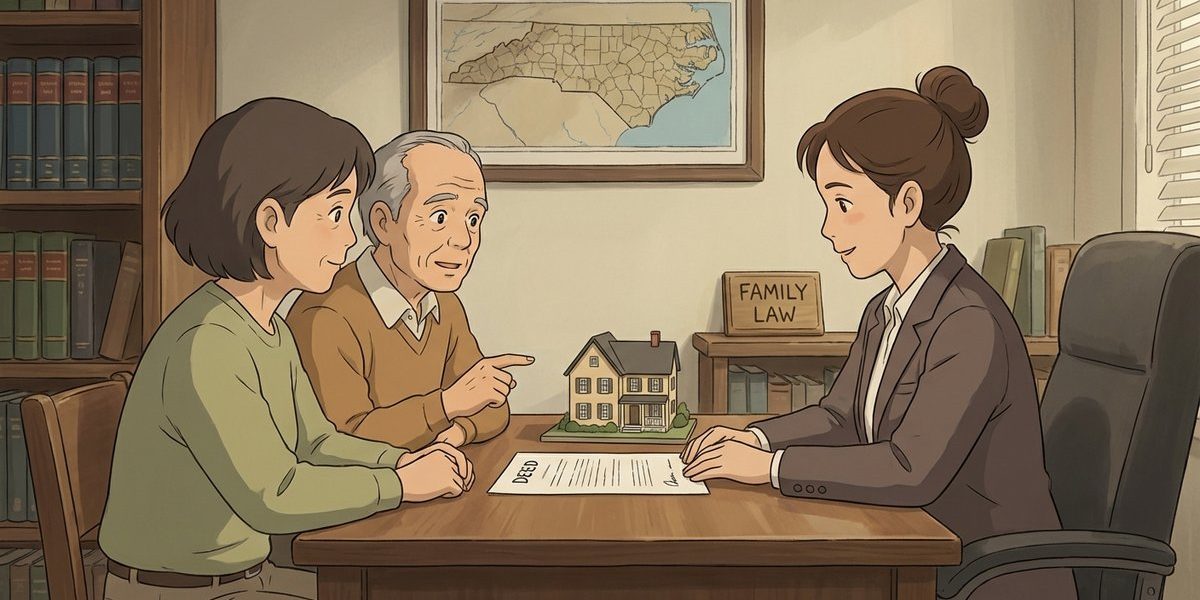
Can my parent’s will leave me the house if the house is jointly titled with the spouse? – North Carolina
Short Answer
Usually, no. In North Carolina, if the home is titled with the spouse with survivorship (most commonly as tenants by the entirety for married couples), the surviving spouse typically becomes the sole owner automatically at death, and the house does not pass under the will.
A will can only give away what the parent owns at death. Even if the deed is not survivorship-based, the spouse may still have statutory rights (like an elective share) that can affect what ultimately passes to a child.
Understanding the Problem
In North Carolina, can a parent use a will to leave a house to an adult child when the house is already titled jointly with the parent’s spouse? The key decision point is how the deed is titled—especially whether the deed includes a survivorship feature that transfers ownership to the spouse automatically at death. The question also often overlaps with spousal rights that can apply even when a will names someone else as beneficiary.
Apply the Law
Under North Carolina law, a will controls only property that is part of the decedent’s probate estate. Many jointly titled deeds transfer ownership at death by operation of law (outside probate). If the home is held as tenants by the entirety (a common form of ownership for married couples), the surviving spouse generally takes full ownership at death, and the deceased spouse has no “share” that can be devised by will. Separately, even when property does pass through the estate, a surviving spouse may have an elective share right that can require the estate to satisfy a statutory minimum for the spouse.
Key Requirements
- How the deed is titled: If the deed is survivorship-based (especially tenancy by the entirety for spouses), the house typically transfers to the surviving spouse automatically at death, regardless of the will.
- What interest the parent actually owns at death: A will can only pass the parent’s probate-owned interest. If the parent’s interest ends at death due to survivorship, there is nothing for the will to transfer.
- Spousal rights against the estate: Even if the house (or other assets) would pass under the will, a surviving spouse may claim an elective share within strict time limits, which can change the final distribution.
What the Statutes Say
- N.C. Gen. Stat. § 41-64 (Tenancy by the entirety; survivorship at death) – On a spouse’s death, tenancy-by-the-entirety property generally belongs to the surviving spouse by survivorship, and the deceased spouse has no descendable interest.
- N.C. Gen. Stat. § 30-3.1 (Elective share) – Gives a surviving spouse a right to claim an elective share based on the length of the marriage and the “Total Net Assets.”
- N.C. Gen. Stat. § 30-3.4 (Elective share procedure and deadline) – Requires an elective share claim to be filed (as an estate proceeding) within six months after letters are issued.
- N.C. Gen. Stat. § 51-3 (Void marriages; bigamy) – States that a marriage is void if either party has a living spouse at the time of the marriage (bigamy).
Analysis
Apply the Rule to the Facts: The facts describe a home owned by a parent and the parent’s spouse, and the spouse refused to add the adult child to the deed. If the deed is held as tenants by the entirety (common for married couples), the parent’s will naming the child as beneficiary generally will not control the house because the spouse would take the home automatically at death by survivorship. If the deed is not survivorship-based (for example, a tenancy in common), then the parent’s share may be devisable by will, but the spouse’s elective share rights could still affect what the estate must provide to the spouse.
Process & Timing
- Who checks title: A trusted family member or attorney (with the parent’s permission). Where: The Register of Deeds in the county where the property is located in North Carolina. What: Obtain the recorded deed and confirm whether it is “tenants by the entirety,” “joint tenants with right of survivorship,” or “tenants in common.” When: As soon as possible while the parent is living, because the deed language usually controls what happens at death.
- Estate-planning step while living: If the goal is for the child to receive the home, the parent typically must change the ownership structure during life (for example, a voluntary sale/conveyance by both spouses, or another mutually agreed title change). If the spouse will not sign, that limits options because tenancy-by-the-entirety property generally cannot be unilaterally conveyed or partitioned by one spouse.
- If the concern is whether the marriage is valid: If there is credible evidence of a prior undissolved marriage, a family-law attorney can evaluate whether an annulment/void-marriage action is appropriate and what proof is needed. This is time-sensitive because litigation after a death can be more complicated and can affect estate administration.
Exceptions & Pitfalls
- Survivorship beats the will: A common mistake is assuming a will can override a survivorship deed. If the deed transfers the home automatically at death, the will usually cannot redirect it.
- “Executor” status does not create ownership: Naming an adult child as executor does not give the child title to a jointly owned home, and it does not prevent survivorship from operating.
- Elective share can still matter: Even if the house does not pass through probate, the spouse may have elective share rights against the estate generally, and those rights have strict deadlines and procedural requirements.
- Void-marriage claims are fact-heavy: Allegations that a prior marriage was never legally ended require careful proof (records searches, divorce decrees, death certificates, and jurisdiction-specific documentation). Acting early while the parent is living can preserve evidence and clarify options.
Conclusion
In North Carolina, a parent’s will usually cannot leave a jointly titled marital home to an adult child if the deed includes survivorship—especially if the spouses own the home as tenants by the entirety—because the surviving spouse typically becomes the sole owner automatically at death. Even when a will can pass a share, the spouse may have elective share rights with a strict deadline. The most important next step is to obtain and review the recorded deed with the Register of Deeds to confirm the exact form of ownership.
Talk to a Family Law Attorney
If you’re dealing with a parent’s will and a house that is jointly titled with a spouse, our firm has experienced attorneys who can help clarify how the deed, survivorship rules, and spousal rights fit together and what options may exist while the parent is still living. Call us today at [CONTACT NUMBER].
Disclaimer: This article provides general information about North Carolina law based on the single question stated above. It is not legal advice for your specific situation and does not create an attorney-client relationship. Laws, procedures, and local practice can change and may vary by county. If you have a deadline, act promptly and speak with a licensed North Carolina attorney.

