
What kind of evidence is usually needed to prove undue influence when challenging a will? – North Carolina
Short Answer
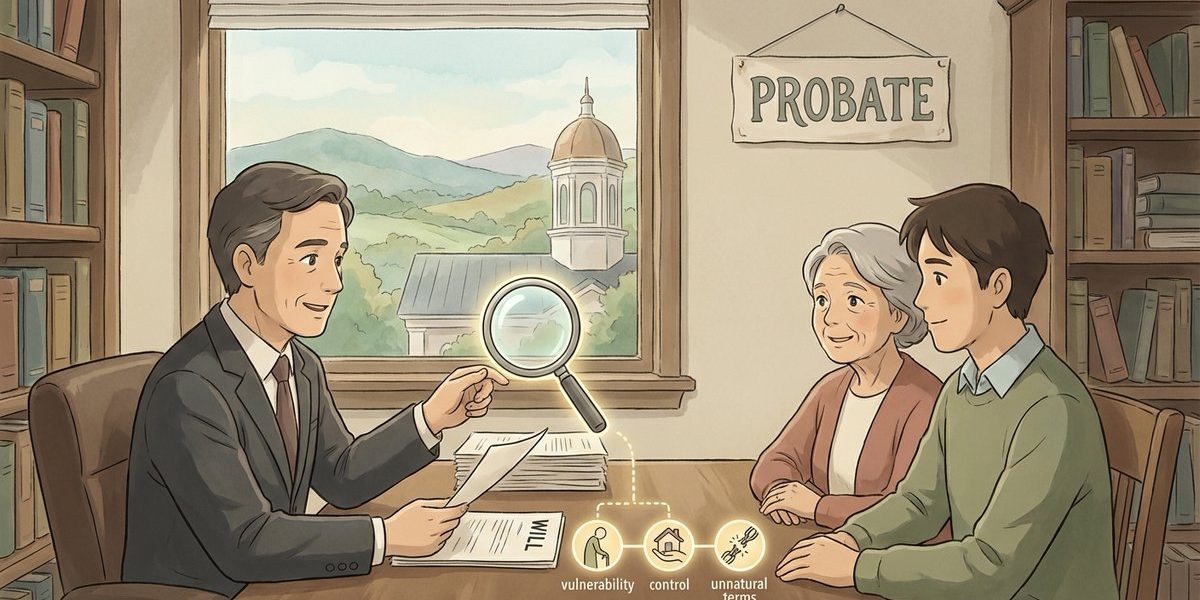
In North Carolina, undue influence is usually proved with circumstantial evidence—patterns and “red flags” surrounding how the will was made—because direct proof is uncommon. Evidence often focuses on the testator’s vulnerability, the beneficiary’s access and control, the beneficiary’s involvement in getting the will signed, and whether the will’s result looks unnatural (for example, cutting out close family without a clear reason). In some situations involving a fiduciary relationship, the evidence can also trigger a presumption that shifts the burden to the will’s proponent to explain the transaction.
Understanding the Problem
In a North Carolina probate dispute, the decision point is whether the will reflects the testator’s free choice or whether someone else’s pressure or control caused the will to be signed. The question focuses on what proof typically matters in an undue influence challenge to a will, not on whether the will is “fair” or whether family members disagree with the outcome. The key is identifying the kinds of facts that tend to persuade a court and jury that the will resulted from improper influence at the time of signing.
Apply the Law
North Carolina courts generally analyze undue influence by looking at whether the testator was susceptible to influence, whether the favored beneficiary had the chance to exert influence, whether that beneficiary was inclined to exert it, and whether the final will shows signs that influence occurred. Because undue influence rarely happens in public, it is commonly proved through surrounding circumstances and reasonable inferences drawn from multiple facts taken together. A will caveat (the procedure used to contest a will) is filed with the Clerk of Superior Court and then transferred to Superior Court for a jury trial.
Key Requirements
- Susceptibility (vulnerability): Proof the testator was in a condition where pressure or control could override independent judgment (often tied to age, illness, dependence, or isolation).
- Opportunity and control: Proof the beneficiary had access and a practical ability to influence the testator (for example, controlling transportation, visitors, communications, or daily care).
- Result that suggests influence: Proof the will’s terms look “unnatural” in context (for example, a sudden change, revoking a long-standing plan, or disinheriting expected heirs) combined with evidence the beneficiary helped bring about the signing.
What the Statutes Say
- N.C. Gen. Stat. § 31-32 (Filing of caveat) – Allows an interested person to file a will caveat, generally within three years after probate in common form (with extensions for certain legal disabilities).
- N.C. Gen. Stat. § 31-33 (Transfer to Superior Court; service; alignment) – Requires transfer of the caveat to Superior Court for a jury trial and sets out service and party-alignment steps.
- N.C. Gen. Stat. § 31-36 (Effect of caveat on estate administration) – Explains how estate administration is restricted while the caveat is pending (including limits on distributions).
Analysis
Apply the Rule to the Facts: Here, the concern is that undue influence may have affected how the will was made. The most useful evidence usually comes from (1) what the testator’s health, dependence, and access to others looked like around the signing, (2) what role the favored beneficiary played in arranging the will, and (3) whether the will made a sharp change that benefits the person who had the most control. In practice, a strong case often combines several categories of proof rather than relying on a single “smoking gun.”
Process & Timing
- Who files: An “interested person” (often an heir or someone named in a prior will). Where: The Clerk of Superior Court in the county where the estate is administered (the decedent’s estate file). What: A caveat to the will. When: Often within three years after the will is probated in common form, subject to limited extensions for certain legal disabilities.
- Transfer and parties: After the caveat is filed, the matter is transferred to Superior Court for a jury trial, and the caveat must be served on interested parties. The court then holds a hearing to align parties (supporting the will versus challenging it).
- Evidence-building phase: The parties typically use discovery (documents, subpoenas, depositions) to gather proof such as medical records, communications, attorney file materials (where available), and witness testimony about the testator’s condition and the beneficiary’s involvement.
Exceptions & Pitfalls
- “Mere persuasion” is not enough: Evidence that a beneficiary asked, argued, or pleaded—without proof of domination or coercion—often does not meet the undue influence standard.
- Look for a pattern, not one fact: A sudden will change alone may not prove undue influence. Courts usually look for multiple surrounding circumstances (vulnerability + control + procurement + unnatural result).
- Procurement evidence matters: Common red flags include the beneficiary selecting the lawyer, driving the testator to the appointment, being present for will discussions, controlling who speaks to the lawyer, or keeping the original will.
- Isolation and gatekeeping: Proof that family and friends had little opportunity to visit or communicate—because the beneficiary controlled access—often becomes central.
- Fiduciary-relationship presumption issues: In some fiduciary relationships existing when the will was executed (for example, certain principal/agent or guardian/ward situations), the facts may support a presumption that shifts the burden of producing evidence to the will’s proponent. But not every close relationship or caregiving arrangement qualifies, and timing matters.
- Don’t overlook neutral witnesses: Testimony from the drafting attorney’s staff, notary, witnesses, neighbors, facility staff, or treating providers can be more persuasive than testimony from interested family members.
Conclusion
In North Carolina, undue influence in a will contest is usually proved through circumstantial evidence showing vulnerability, opportunity and control by the favored beneficiary, a willingness to exert that influence, and a will result that looks inconsistent with the testator’s free choice. The typical next step is to gather records and witnesses and, if warranted, file a will caveat with the Clerk of Superior Court—often within three years after probate in common form.
Talk to a Probate Attorney
If a will appears to have been shaped by pressure, isolation, or control, a probate attorney can help evaluate the available evidence, preserve records, and track the caveat deadline. If you’re dealing with a possible undue influence will contest in North Carolina, our firm has experienced attorneys who can help you understand your options and timelines. Call us today at 919-341-7055.
Disclaimer: This article provides general information about North Carolina law based on the single question stated above. It is not legal advice for your specific situation and does not create an attorney-client relationship. Laws, procedures, and local practice can change and may vary by county. If you have a deadline, act promptly and speak with a licensed North Carolina attorney.

