
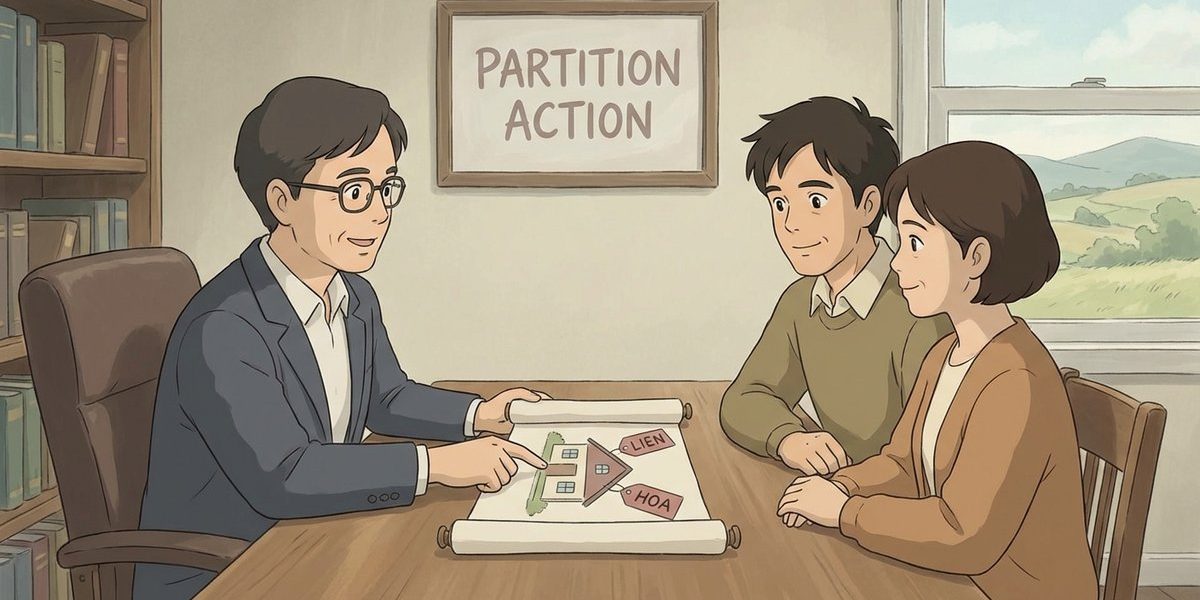
What happens if HOA dues aren’t paid while a partition case is pending, and can the HOA foreclose on the property? – North Carolina
Short Answer
In North Carolina, HOA dues usually keep accruing during a pending partition case, and the HOA can typically record a lien for unpaid assessments and may be able to foreclose even while the partition case is ongoing. A partition filing does not automatically stop HOA collection or foreclosure. Practically, unpaid dues can reduce the net sale proceeds and create leverage for the HOA, so co-owners often address HOA payments early and then sort out reimbursement and credits inside the partition case.
Understanding the Problem
In a North Carolina partition action involving inherited property in an HOA, what happens if the co-owners do not pay HOA dues while the case is pending, and can the HOA foreclose on the property anyway? The decision point is whether the pending partition case changes the HOA’s ability to enforce unpaid assessments against the home while co-owners are fighting about possession and sale.
Apply the Law
Under North Carolina law, HOA/association assessments are generally obligations tied to the property, and nonpayment can lead to a recorded lien and, in many communities, a foreclosure action. A partition case (usually handled in the office of the Clerk of Superior Court) is designed to divide or sell co-owned property, but it does not automatically pause outside creditors. During the partition case, co-owners can also ask the court to account for “carrying costs” paid to preserve the property and to credit or reimburse the paying co-owner from sale proceeds.
Key Requirements
- HOA dues can become a lien: If assessments are not paid, the association may be able to record a lien against the property after the statutory waiting period and required filings.
- Foreclosure may still be possible: Depending on the type of community and the governing documents, the association may be able to foreclose its lien through a court process, even if a partition case is pending.
- Partition can still address fairness between co-owners: In the partition case, a co-owner who pays property “carrying costs” to preserve the property can seek contribution/credit so the financial burden is allocated among co-owners rather than falling on only one person.
What the Statutes Say
- N.C. Gen. Stat. § 47A-22 (Liens for unpaid common expenses; foreclosure) – For condominium associations, unpaid common expenses can become a lien after 30+ days and may be foreclosed by suit in a manner similar to a mortgage.
- N.C. Gen. Stat. § 46A-27 (Carrying costs; right to contribution) – In a partition case, a cotenant can seek contribution for certain carrying costs paid to preserve the property (defined to include items like taxes, insurance, repairs, and acquisition-loan payments).
Analysis
Apply the Rule to the Facts: Here, multiple siblings appear to co-own a home in an HOA, and one sibling is living in the property and refusing to cooperate. If HOA dues are not paid during the partition case, the HOA may record a lien and pursue collection, and in some communities it may also pursue foreclosure despite the pending partition. If another sibling pays the HOA to prevent enforcement, that payment can become part of the financial accounting in the partition case so the paying sibling can seek an appropriate credit or reimbursement when the property is sold.
Process & Timing
- Who acts: The HOA/association typically records and enforces its lien; a co-owner may also act to keep the account current. Where: HOA liens are typically recorded with the Clerk of Superior Court in the county where the property sits; the partition case is also typically handled through the Clerk of Superior Court. What: The HOA’s recorded claim is usually a “claim of lien” (the exact title varies by community type and documents). When: For condominiums, the lien can arise once assessments are unpaid for 30 days or longer and then properly recorded.
- During the partition case: A co-owner who pays to prevent HOA enforcement can ask the partition court to account for those payments as part of the case’s financial adjustments (credits/debits) so the cost is shared in a fair way.
- End of the case: If the property is sold through partition, liens and closing costs are typically addressed from the sale proceeds before co-owners receive their shares, and then the court distributes the net proceeds after any approved credits and reimbursements.
Exceptions & Pitfalls
- Condo vs. planned community rules: North Carolina has different statutory schemes depending on whether the property is a condominium or another type of HOA-governed community. The foreclosure tools and notice requirements can differ, so the governing declaration and the applicable statute matter.
- Assuming “partition stops foreclosure”: A pending partition case does not automatically stop an HOA from enforcing its lien. Stopping a foreclosure usually requires a specific court order, a payoff, or another legal basis.
- Letting the occupant control payments: When one co-owner stays in the home and refuses to cooperate, HOA nonpayment can become a pressure point that harms all co-owners. Even if one sibling “caused” the problem, the lien attaches to the property and can reduce everyone’s net recovery.
- Not documenting payments: If a co-owner pays HOA dues to protect the property, keeping clear proof of payment and dates is critical to request proper credits in the partition accounting.
Conclusion
In North Carolina, HOA dues generally continue to accrue while a partition case is pending, and a pending partition does not automatically prevent the HOA from recording a lien and (in many cases) pursuing foreclosure for unpaid assessments. Unpaid dues can reduce net sale proceeds and complicate the case. A practical next step is to keep the HOA account current (or negotiate a written payoff/hold) and then promptly file a request in the partition case to credit the paying co-owner for those carrying-cost payments.
Talk to a Partition Action Attorney
If a co-owner is living in inherited HOA property and dues are going unpaid during a partition case, an attorney can help protect the property from enforcement and present a clear request for credits and reimbursements in the partition accounting. Call us today at (919) 341-7055.
Disclaimer: This article provides general information about North Carolina law based on the single question stated above. It is not legal advice for your specific situation and does not create an attorney-client relationship. Laws, procedures, and local practice can change and may vary by county. If you have a deadline, act promptly and speak with a licensed North Carolina attorney.

