
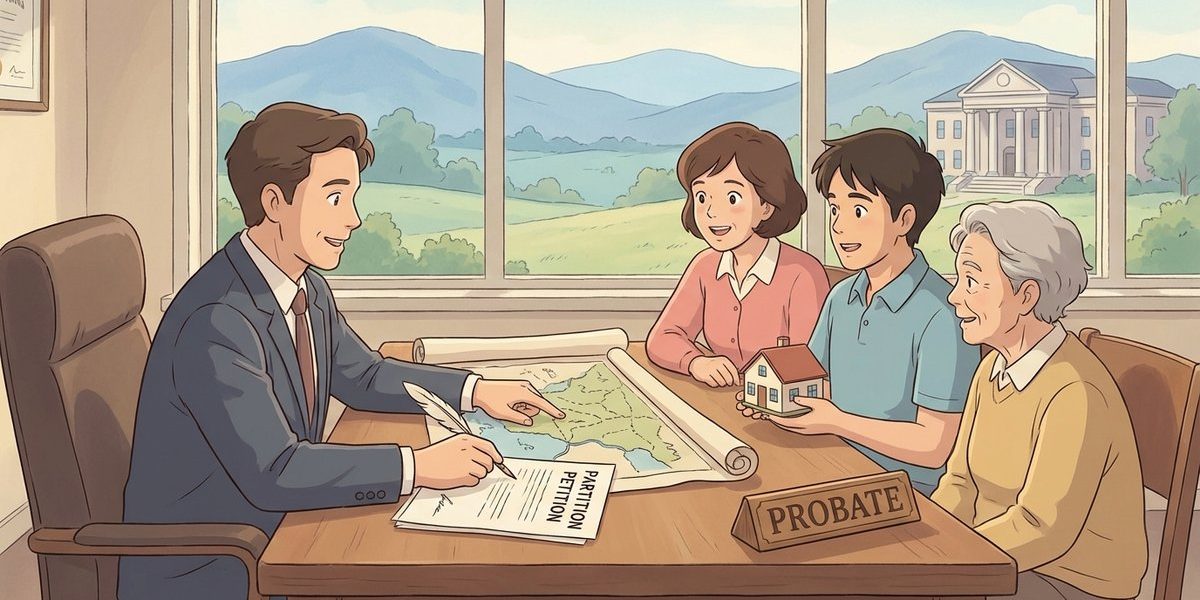
What happens if some family members want to sell the entire property but others only want a part? – North Carolina
Short Answer
In North Carolina, when family members co-own inherited real estate and cannot agree on selling the whole property versus only part, the usual legal solution is a partition case in Superior Court. The court can order a physical division, a sale of all or part, or even a mix (divide some and sell some), depending on what is practical and fair. If the property is still in an active estate administration, a personal representative may also have separate authority to take control or sell for estate purposes, but co-owners generally cannot force each other to accept a partial sale without a legal process.
Understanding the Problem
In North Carolina probate situations, inherited real estate often ends up owned by multiple heirs or devisees at the same time. The decision point is simple: when co-owners disagree about selling the entire property versus selling only part of it, what legal process decides the outcome? This question commonly comes up when a deed description suggests the house and surrounding land may involve separate parcels, or when one group wants a clean sale while another wants to keep a portion. The same disagreement can also overlap with a separate issue: whether an occupant can be required to move out when multiple family members have ownership rights.
Apply the Law
North Carolina treats partition as a special court proceeding used to end co-ownership when the owners cannot agree. A cotenant (a co-owner, such as an heir who inherited an undivided interest) can file for partition in the Superior Court. The court then chooses the method of partition allowed by statute, which can include dividing the land, selling it, or doing a combination that addresses different parts of the property.
Key Requirements
- Co-ownership interest: The person asking the court to act must claim an ownership share as a tenant in common or joint tenant (common with inherited property).
- All co-owners joined: All cotenants must be brought into the case so the court can enter an order that binds everyone’s interests.
- Feasible remedy (divide vs. sell): The court decides whether a physical split is workable or whether a sale (of all or part) is necessary to avoid substantial harm to the owners’ interests.
What the Statutes Say
- N.C. Gen. Stat. § 46A-1 (Partition is a special proceeding) – establishes that partition follows special-proceeding rules.
- N.C. Gen. Stat. § 46A-21 (Who may petition; necessary parties) – allows a cotenant (and in some situations a personal representative) to petition and requires joining all cotenants.
- N.C. Gen. Stat. § 46A-26 (Methods of partition) – allows the court to order an actual division, a sale, a mix of division and sale, or partition of part while addressing the remainder (with limits).
- N.C. Gen. Stat. § 46A-75 (Sale in lieu of actual partition) – permits a sale only if actual division cannot be done without substantial injury, and places the burden on the party asking for a sale.
Analysis
Apply the Rule to the Facts: The facts describe inherited property where the deed may treat the house and parts of the land as separate parcels, and family members disagree about selling everything versus only part. That disagreement fits the core purpose of a partition case: ending co-ownership when consensus is not possible. If the deed and survey information show truly separate parcels (for example, a house lot and an adjoining tract), the court has statutory tools to address part of the property differently from the rest, including dividing or selling only certain portions under the partition statute.
Process & Timing
- Who files: Any cotenant (co-owner) may file. Where: North Carolina Superior Court in the county where the real property (or some part of it) is located. What: A partition petition (a special proceeding) naming and serving all cotenants and other interested parties as needed. When: There is no single universal “days-after-death” deadline to start partition, but timing matters if an estate is still open or if a sale is being planned.
- Early case issues: The court identifies the ownership interests and the property to be partitioned. If the deed suggests separate parcels, the case often turns on getting clear legal descriptions and confirming what is actually being partitioned.
- Decision on remedy: The court determines whether to order an actual division, a sale, or a combination (such as dividing one portion and selling another). If a party asks for a sale instead of a division, that party must prove that a physical split would cause substantial injury under the statute.
Exceptions & Pitfalls
- “Sell part” may not be realistic without a legal description: A family agreement to sell “just the back acreage” can fail if there is no separate parcel, no survey, or no clear way to split access, utilities, or road frontage. Partition cases often require careful mapping of what can actually be divided.
- Co-owner occupancy is not the same as a tenant eviction: If an occupant is also a cotenant, North Carolina law generally treats each cotenant as having a right to possess the whole property, making a simple “move out” demand harder to enforce without showing an ouster or using the right court remedy. (If the occupant is not an owner, different rules may apply.)
- Estate administration can change who has authority: If a personal representative needs to sell real estate to pay estate debts or expenses, that can involve a separate probate process and required notice to heirs/devisees. In some situations, heirs can sell, but the personal representative may need to join to pass good title while the estate is open.
- Leaving out an owner can derail the result: Partition and estate sale procedures are sensitive to proper parties and service. Missing an heir or failing to properly join all cotenants can create serious title problems.
Conclusion
When North Carolina family members co-own inherited real estate and disagree about selling the whole property versus only part, the usual legal path is a partition special proceeding in Superior Court. The court can order a physical division, a sale, or a combination that treats different parts of the property differently, depending on what can be done without substantial injury. The most important next step is to file a partition petition in the Superior Court in the county where the land is located once agreement is not possible.
Talk to a Probate Attorney
If a family is dealing with an inherited property dispute about selling the entire property versus only part, a probate attorney can help clarify the deed, confirm who owns what, and explain the court process and timelines for partition or estate-related sales. Call us today at (919) 341-7055.
Disclaimer: This article provides general information about North Carolina law based on the single question stated above. It is not legal advice for your specific situation and does not create an attorney-client relationship. Laws, procedures, and local practice can change and may vary by county. If you have a deadline, act promptly and speak with a licensed North Carolina attorney.

