
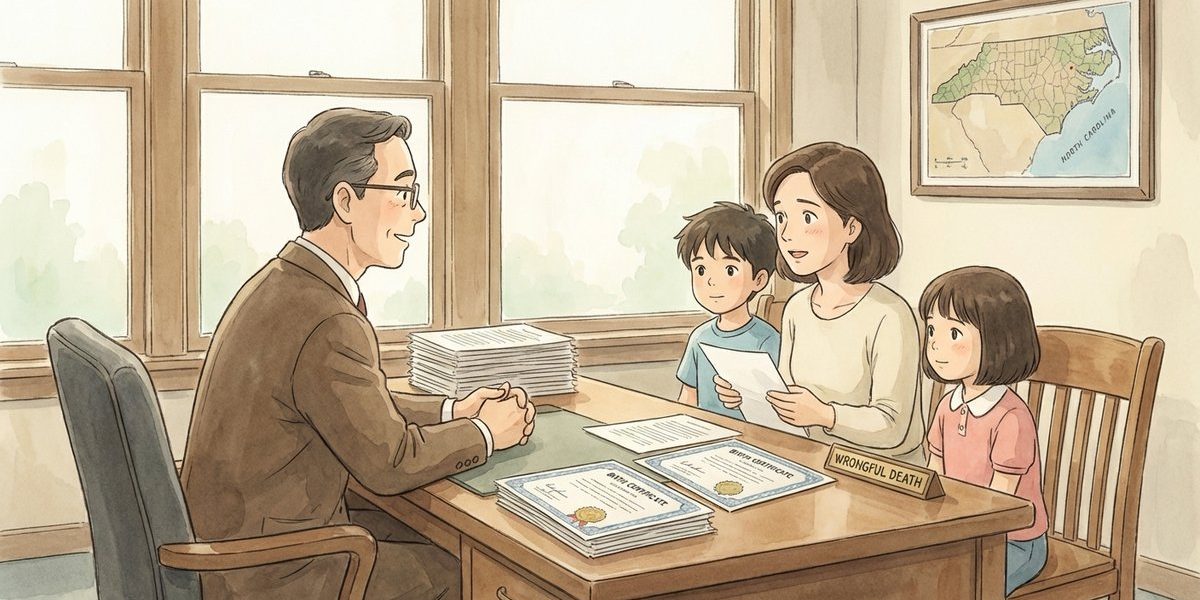
Can I apply for survivor benefits for the children if the children are on the birth certificates but the death certificate doesn’t list me as the spouse? – North Carolina
Short Answer
Yes, in many situations in North Carolina a parent or guardian can still apply for survivor-type benefits for the children even if the death certificate incorrectly lists the decedent as not married. The key issue is usually proving the children’s relationship to the decedent (often shown by birth certificates) and, depending on the benefit program, proving dependency or eligibility. Separately, if the marriage status is wrong, it is often important to correct the death certificate because some benefits pay first to a surviving spouse unless the spouse is shown to exist.
Understanding the Problem
In North Carolina, after a spouse dies in a vehicle crash, can a surviving parent apply for survivor benefits for the children when the children appear on the birth certificates, but the death certificate lists the decedent as not married? The decision point is whether the benefit program focuses on the children’s status as the decedent’s children (and possibly their dependency) versus requiring proof that a surviving spouse exists. Timing and paperwork matter because agencies and insurers often rely on the death certificate as a starting document, even when other records show a valid marriage.
Apply the Law
North Carolina does not have one single “survivor benefits” application that covers every situation. Different programs (workers’ compensation death benefits, certain state line-of-duty benefits, and estate-based allowances) use different eligibility rules. Across most programs, the children’s eligibility typically turns on proof of parentage and age, and sometimes dependency. If the death certificate is wrong about marital status, that error can still create delays because many programs pay a surviving spouse first, and only pay children directly if there is no surviving spouse or if the spouse is not eligible under that program.
Key Requirements
- Proof the children are the decedent’s children: Birth certificates and related records usually establish the parent-child relationship for benefit processing.
- Program-specific eligibility (often age and dependency): Some benefits require the children to be minors or otherwise “dependent,” while others presume dependency for a spouse and children in certain settings.
- Correct identification of the proper payee: Many benefit systems prioritize payment to a surviving spouse first; if the death certificate incorrectly says “not married,” the agency may initially treat the case as “no spouse,” which can affect how the claim is processed.
What the Statutes Say
- N.C. Gen. Stat. § 97-39 (Workers’ compensation death benefits; dependency) – In workers’ compensation death claims, a widow/widower and children are conclusively presumed dependent in many cases, while other dependency questions depend on the facts.
- N.C. Gen. Stat. § 143-166.3 (Certain line-of-duty death benefits; order of payment) – For covered line-of-duty deaths, payment generally goes to the spouse first; if no spouse, then to dependent children.
- N.C. Gen. Stat. § 30-17 (Child’s allowance from an estate) – Eligible children may seek a child’s allowance through an estate proceeding; if a personal representative is appointed, a claim must generally be made within six months after letters issue.
- N.C. Gen. Stat. § 30-27 (Additional allowance; deadline) – A surviving spouse or child may seek an additional allowance through a clerk of court proceeding, generally within one year of death (or within six months after letters issue if an estate is opened).
Analysis
Apply the Rule to the Facts: The facts describe children whose birth certificates identify the decedent as a parent, which is commonly the core proof needed to apply for child-based survivor benefits. The death certificate listing the decedent as “not married” can still cause administrative problems because some programs pay a spouse first and only pay children if there is no spouse, so the marital-status error may need to be corrected or explained with a marriage certificate. If the benefit is tied to an estate proceeding, the clerk of superior court process and deadlines can matter even when the children’s parentage is clear.
Process & Timing
- Who files: Typically the surviving parent, legal guardian, or personal representative depending on the benefit. Where: The agency or forum that controls the benefit (for example, the North Carolina Industrial Commission for workers’ compensation death benefits, or the Clerk of Superior Court for estate allowances). What: Commonly requested documents include the death certificate, children’s birth certificates, and any marriage certificate or court record that proves marital status. When: If an estate is opened and letters are issued, some estate-based child allowance claims must generally be filed within six months after the issuance of letters.
- Fix the paperwork mismatch: When the death certificate conflicts with a marriage certificate, the benefit administrator may request additional proof or a corrected death certificate before releasing funds or before deciding who should receive payments.
- Confirm the correct benefit track: A vehicle-crash death can involve multiple tracks at once (insurance claims, possible workers’ compensation if the death occurred in the course of employment, and estate proceedings). Each track can have its own forms and review time, and processing can vary by county and agency workload.
Exceptions & Pitfalls
- Different programs use different definitions: “Survivor benefits” can mean workers’ compensation death benefits, a line-of-duty benefit, or an estate allowance, and each has different eligibility rules and who gets paid first.
- Death certificate errors can stall claims: Even when a marriage certificate exists, an incorrect “not married” entry can trigger extra review, requests for proof, or disputes about who should receive payments.
- Estate deadlines can be missed: If an estate is opened, some allowance claims have a short filing window tied to when letters issue, not just the date of death.
- Guardianship and payment to minors: When benefits are payable to children, agencies may require a guardian, custodial parent documentation, or court authority before releasing funds for minors.
Conclusion
In North Carolina, children can often qualify for survivor-type benefits based on proof that they are the decedent’s children, even if the death certificate incorrectly lists the decedent as not married. The practical issue is that some programs pay a surviving spouse first and only pay children directly if there is no spouse, so the marital-status error may need to be corrected or supported with a marriage certificate. If an estate is open, the next step is to file the appropriate petition with the Clerk of Superior Court within six months after letters issue.
Talk to a Wrongful Death Attorney
If a family is dealing with a fatal crash and paperwork problems like a death certificate that does not list the marriage, our firm has experienced attorneys who can help sort out what documents matter for each benefit track and what deadlines apply. Call us today at (919) 341-7055.
Disclaimer: This article provides general information about North Carolina law based on the single question stated above. It is not legal advice for your specific situation and does not create an attorney-client relationship. Laws, procedures, and local practice can change and may vary by county. If you have a deadline, act promptly and speak with a licensed North Carolina attorney.

