
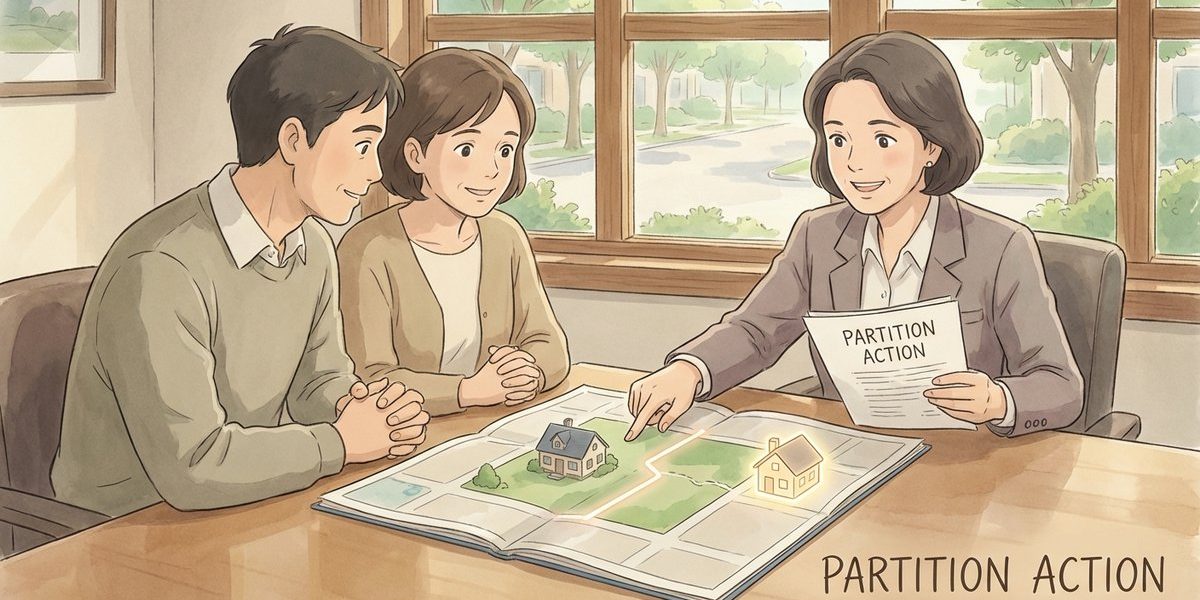
If the house and land are tied together as one property, can I still force a sale, or do I need to separate titles first? – North Carolina
Short Answer
In North Carolina, a co-owner can usually file a partition case to force a division or sale of the property as it is titled, even when the house and land are part of one parcel. Separate titles are not required just because the improvements (the home) sit on the land. The court can order an in-kind division, a sale of the whole, or a mix of both, depending on what avoids “substantial injury” to the co-owners.
Understanding the Problem
When real estate in North Carolina is owned by two people together, can one co-owner force an end to co-ownership when the home and the land are treated as one property on the deed? If the property is a single parcel, does a co-owner have to split it into separate lots or separate titles before asking the court to order a sale? The decision point is whether the court can handle the property as one unit in a partition case, or whether a title separation must happen first.
Apply the Law
North Carolina handles partition through a court “special proceeding.” In a partition case, the court chooses a method that ends (or, in limited situations, partially ends) the co-ownership. The court may order a physical division of the land (often called “actual partition”), order a sale instead of a physical split (“partition sale”), or use a combination approach. A party who wants a sale (instead of a physical split) must prove that a physical division cannot be done without “substantial injury” to one or more parties.
Key Requirements
- Co-ownership interest: The petitioner must have an ownership interest shown in the current title (for example, tenants in common or joint tenants).
- Identifiable real property to partition: The petition must describe the real property as it exists in the public records (often a single parcel that includes both land and improvements like a house).
- Proper method of partition: The court must select a method allowed by statute, and a sale requires proof (by the party requesting it) that a physical split would cause “substantial injury.”
What the Statutes Say
- N.C. Gen. Stat. § 46A-1 (Partition is a special proceeding) – Partition cases are handled as special proceedings with specific procedures.
- N.C. Gen. Stat. § 46A-26 (Methods of partition) – The court may order an actual partition, a partition sale, or a combination, and cannot force continued co-ownership over a co-owner’s objection.
- N.C. Gen. Stat. § 46A-75 (Sale in lieu of actual partition) – A sale requires proof that a physical split cannot be made without substantial injury, and the court must make specific findings to support a sale order.
- N.C. Gen. Stat. § 46A-52 (Partition where cotenants unknown or title disputed) – The court can move forward with partition even if some ownership shares are disputed, and resolve disputes later.
Analysis
Apply the Rule to the Facts: The property is titled to two co-owners, so the co-ownership requirement is met. Because the home and land are “tied together” as one parcel on the deed, the case typically proceeds using that single legal description; separating titles first is not a standard prerequisite to filing. If a physical split would not work well (for example, one house sitting on one lot), the party asking for a sale generally focuses on proving “substantial injury” from an actual partition so the court can order a sale of the whole property.
Process & Timing
- Who files: A co-owner (the petitioner). Where: The Clerk of Superior Court in the county where the property is located in North Carolina. What: A partition petition describing the property as titled (usually by the deed’s legal description) and stating the ownership interests. When: North Carolina partition statutes do not set one universal “file by” deadline; timing usually turns on practical goals (for example, stopping ongoing conflict or moving toward a refinance).
- Method decision: The court determines the proper method under Chapter 46A. If a sale is requested, the petitioner should be prepared to present evidence showing why an actual partition would cause substantial injury, and the court must enter findings to support a sale order.
- Sale and distribution: If the court orders a partition sale, the property is sold under court supervision and the net proceeds are distributed according to each party’s ownership interest, subject to liens and other allowed adjustments addressed in the proceeding.
Exceptions & Pitfalls
- Sale is not automatic: If one co-owner asks for a sale, North Carolina law places the burden on that party to prove “substantial injury” from a physical division, and the court must support a sale with specific findings.
- “House and land” usually stay together: A common mistake is assuming the home can be “separated” from the land by paperwork alone. If the deed describes one parcel, the court generally treats it as one property and decides whether to divide the land, sell it, or do a combination approach allowed by statute.
- Mortgage in one name does not end co-ownership: A loan in only one co-owner’s name does not, by itself, remove the other person from title. Also, a partition case does not automatically remove a borrower from a mortgage; that usually requires payoff at closing or a refinance approved by the lender.
- Title disputes can complicate, but not always stop, the case: If the other side disputes ownership shares, the court may still order a partition or sale and sort out the disputed interests afterward under the statute.
Conclusion
In North Carolina, a co-owner can usually pursue partition of a single parcel that includes both the land and the house without separating titles first. The court can order an actual partition, a sale, or a combination method, but a sale requires proof that a physical split would cause substantial injury. The next step is to file a partition petition with the Clerk of Superior Court in the county where the property is located and be prepared to address whether an actual partition is workable or whether a sale is necessary.
Talk to a Partition Action Attorney
If you’re dealing with co-ownership of a home and need to force a sale or understand whether the court will divide or sell the property, our firm has experienced attorneys who can help you understand your options and timelines. Call us today at (919) 341-7055.
Disclaimer: This article provides general information about North Carolina law based on the single question stated above. It is not legal advice for your specific situation and does not create an attorney-client relationship. Laws, procedures, and local practice can change and may vary by county. If you have a deadline, act promptly and speak with a licensed North Carolina attorney.

