
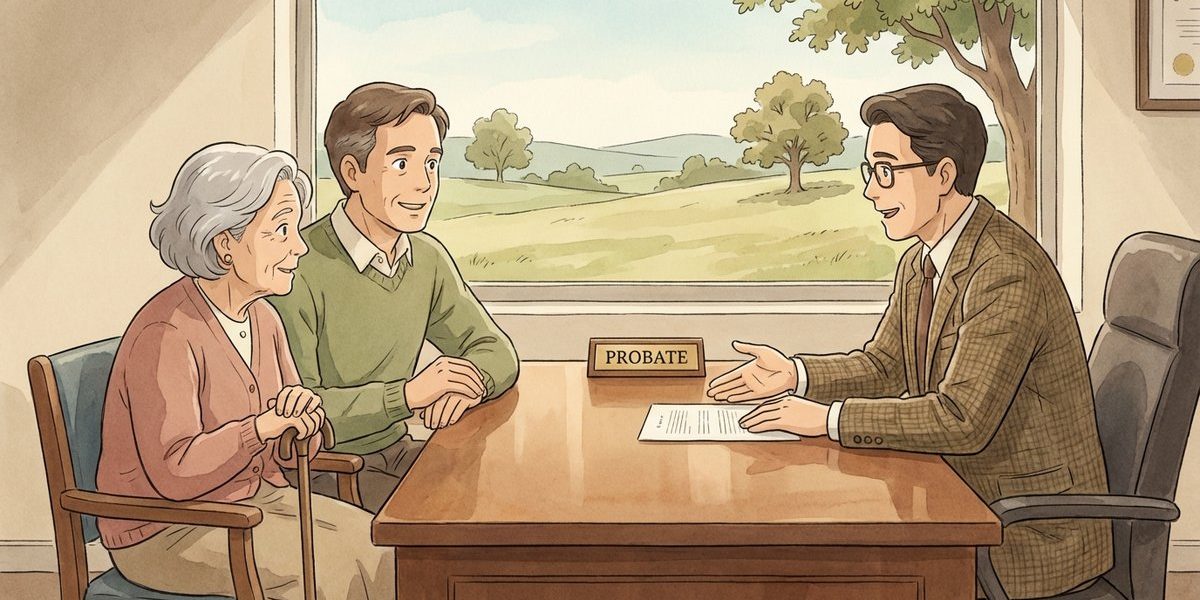
What are my options if a relative is pressuring me to sell the home but my other parent is still living there and needs care? – North Carolina
Short Answer
In North Carolina, a relative usually cannot force the sale of a home that is still owned by a living parent who is mentally capable, unless that parent agrees or a court gets involved through a proper legal process. A power of attorney does not automatically allow a sale just because another family member wants one, and it must be used for the parent’s benefit. If a parent later dies owning real estate, the ability to sell depends on how the property is titled, whether there is a will, and whether the personal representative has authority to sell without court approval.
Understanding the Problem
In North Carolina probate and elder-care situations, the key question is: can a family member pressure or force a sale of a home when one parent is still alive, still mentally capable, and still living in the home with care needs? The decision point usually turns on who legally owns the home right now and whether the living parent has agreed to sell (personally or through valid authority). A related timing issue is what changes if the parent dies soon and the property is still titled in the deceased parent’s name or becomes part of an estate.
Apply the Law
North Carolina law treats a sale very differently depending on whether the owner is alive or the owner has died. While a parent is alive and mentally capable, that parent controls whether to sell, and a power of attorney holder must act for the parent’s benefit and within the authority granted in the document. After death, real estate may be sold through estate administration, but the path depends on whether the personal representative has a power of sale under the will (or a will provision that effectively grants it) or must file a special proceeding with the Clerk of Superior Court in the county where the land is located. Separately, if multiple people own interests in the same property, a co-owner may be able to file a partition action in Superior Court to divide or sell the property, but life-estate rules can limit interference with a life tenant’s possession.
Key Requirements
- Current ownership and capacity: If the living parent owns the home and remains mentally capable, that parent’s consent (or valid authority exercised for the parent’s benefit) drives whether a sale can happen.
- Proper authority to sell: After a death, a personal representative may be able to sell without court approval only if the will gives a power of sale (or includes language that grants similar authority). Otherwise, the personal representative typically needs a court-supervised special proceeding to sell for debts, claims, expenses, or the estate’s advantage.
- Correct court process for co-owned property: If heirs or other co-owners end up sharing title, a partition action can sometimes force a sale, but a life estate can protect the life tenant’s right to stay in possession during the life estate.
What the Statutes Say
- N.C. Gen. Stat. § 35A-1302 (Sale, mortgage, or exchange of a ward’s real estate; procedure when land is in a different county) – Sets a process for a guardian seeking court authority to sell a ward’s real estate, including coordination between Clerks when the land is in a different county than the guardianship.
- N.C. Gen. Stat. § 35A-1307 (Special proceeding for sale of real property of an incompetent spouse in limited circumstances) – Allows a spouse, in narrow circumstances, to bring a special proceeding before the Clerk to sell an incompetent spouse’s real property for support, with required court approvals.
- N.C. Gen. Stat. § 46A-79 (Partition sale of remainder or reversionary interest; life estate does not bar partition) – Allows partition of remainder/reversion interests even if a life estate exists, but the partition cannot interfere with the life tenant’s possession during the life estate.
- N.C. Gen. Stat. § 46A-78 (Partition sale subject to a life estate; valuation/payment to life tenant who joins) – Addresses how a life tenant who joins a partition-by-sale receives a calculated value from sale proceeds.
- N.C. Gen. Stat. § 46A-82 (Partition sale for public purposes) – Provides a partition-sale procedure when property is required for public purposes and the court finds the sale promotes the cotenants’ interests.
Analysis
Apply the Rule to the Facts: Here, one parent is still alive and mentally capable but needs significant care, and a relative is pushing for a sale. If the living parent owns the home (or has a protected right to live there, such as a life estate), a relative’s pressure does not create legal authority to sell. If the other parent has already died and real property is believed to be titled in the deceased parent’s name, the ability to sell after death will depend on estate administration: whether a personal representative has a power of sale under a will or must use a Clerk-supervised special proceeding, and whether any co-owners later seek partition.
Process & Timing
- Who files: If the issue is selling after a death, the personal representative (executor/administrator) typically drives the process; if the issue is co-owners disagreeing, a co-owner may file a partition action. Where: Estate sale proceedings and many estate matters are handled by the Clerk of Superior Court in the county where the land is located; partition actions are filed before the Clerk of Superior Court in the county where the property (or part of it) is located. What: A petition/special proceeding to sell real estate (estate administration) or a partition petition/complaint (co-ownership dispute). When: Timing often becomes urgent after death if the estate needs cash to pay claims and expenses, or if family conflict is escalating; exact deadlines depend on the type of proceeding and local practice.
- Sale authority decision: In an estate, the personal representative must determine whether the will grants authority to sell without court approval. If not, the personal representative generally proceeds through a Clerk-supervised sale process. In a court-supervised sale, the court can require a public sale unless it authorizes a private sale, and judicial sales commonly include an upset-bid period.
- Closing and distribution: After an authorized sale closes, proceeds typically go first to administration costs and then to valid claims in the order required by North Carolina law, with any remaining balance distributed to the people entitled to it under the will or intestacy rules. If heirs want to sell and the estate does not need the proceeds, the personal representative may still need to join in the conveyance so good title passes.
Exceptions & Pitfalls
- Power of attorney limits: A power of attorney is not a “family vote.” It must be used for the parent’s benefit and within the document’s authority. Using it mainly to satisfy another relative’s wishes can trigger disputes and court involvement.
- Title surprises: “Believed to be titled” is a common problem. Deeds may show joint ownership, a life estate, a trust transfer, or other arrangements that change who must sign and whether a sale can be forced.
- Partition risk after death: If multiple heirs end up owning the property together, one co-owner may try to force a sale through partition. A life estate can limit interference with the life tenant’s possession, but it does not always prevent litigation over the remainder interest.
- Wrong forum: Estate-sale authority issues often belong with the Clerk of Superior Court (special proceeding), while co-owner disputes often belong before the Clerk of Superior Court (partition). Filing in the wrong place can waste time when care needs are urgent.
- Sale process details: Court-supervised sales can involve public sale requirements, court approval steps, and an upset-bid period. Families sometimes agree to a deal and then get surprised by required court steps that affect timing.
Conclusion
In North Carolina, a relative’s pressure alone does not create legal power to sell a home when a parent is still alive and mentally capable, especially when that parent is living there and needs care. If a parent later dies owning real estate, the sale process depends on title and estate authority: a personal representative may sell without court approval only if the will grants a power of sale; otherwise, a special proceeding before the Clerk of Superior Court is usually required. Next step: confirm the current deed and, if a death occurs, open the estate and file the proper sale petition with the Clerk in the county where the land is located.
Talk to a Probate Attorney
If a family member is pushing for a sale while a parent still lives in the home and needs care, our firm has experienced attorneys who can help clarify who has legal authority, what court process applies, and what timelines to expect. Call us today at (919) 341-7055.
Disclaimer: This article provides general information about North Carolina law based on the single question stated above. It is not legal advice for your specific situation and does not create an attorney-client relationship. Laws, procedures, and local practice can change and may vary by county. If you have a deadline, act promptly and speak with a licensed North Carolina attorney.

