
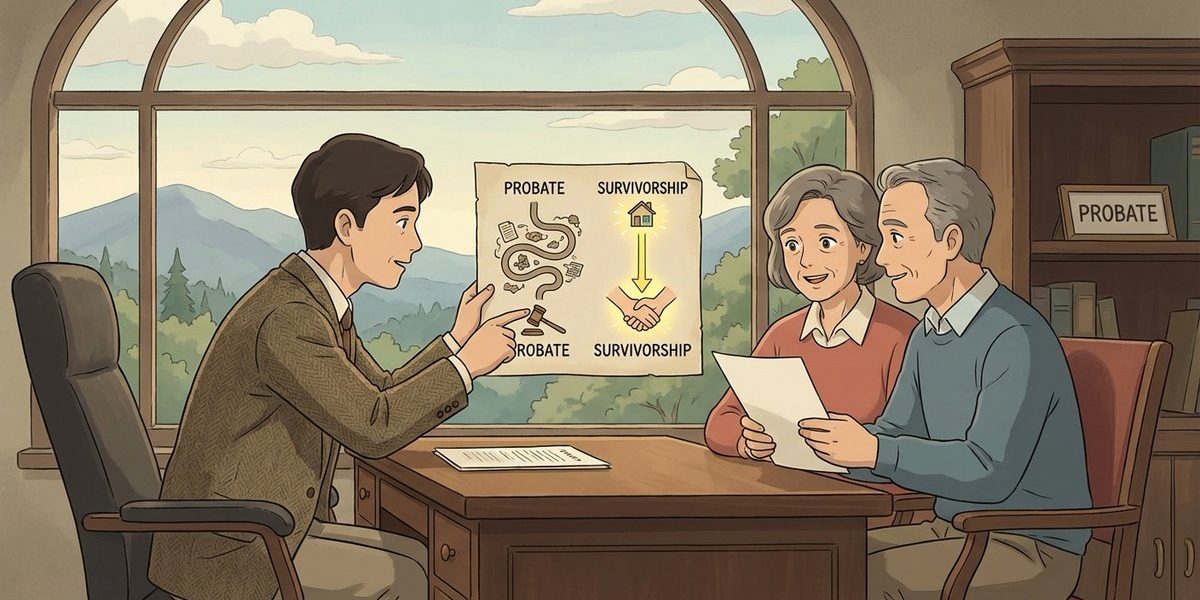
What estate assets bypass probate when they are owned jointly with others? – North Carolina
Short Answer
In North Carolina, property owned with a true right of survivorship usually passes automatically to the surviving co-owner and does not pass under the will through probate. Common examples include joint bank accounts or jointly owned securities that clearly state survivorship, and (for spouses) property held as tenants by the entirety. However, some survivorship assets can still be pulled into the estate only if needed to pay certain estate claims, even though the will generally does not control who ultimately receives them.
Understanding the Problem
When a parent dies in North Carolina and leaves assets titled jointly with others, the key question is whether the co-ownership was set up so the surviving owner automatically takes the asset at death, or whether the deceased owner’s share must be handled through the estate. The decision point is whether the title or account agreement creates a right of survivorship (or, for spouses, a survivorship form of ownership). If survivorship applies, the asset typically transfers outside probate; if it does not, the deceased owner’s share is usually part of the probate estate and is handled by the Clerk of Superior Court through the estate administration process.
Apply the Law
North Carolina treats jointly owned property differently depending on the form of ownership. If the ownership includes a right of survivorship, the deceased owner’s interest generally passes to the surviving owner by operation of law. If the ownership is tenants in common (or joint ownership without survivorship), the deceased owner’s share generally becomes part of the probate estate and is controlled by the will (or intestacy if there is no will). Even when an asset passes by survivorship, North Carolina law can allow limited recovery of certain survivorship assets to pay specific estate claims if the estate does not have enough other assets.
Key Requirements
- Survivorship must be clearly created: The deed, account agreement, or registration must show a right of survivorship (or otherwise clearly show intent that the survivor takes at death). If survivorship is not clearly created, the law often treats the owners as tenants in common.
- Type of co-ownership controls probate: Joint tenancy with survivorship typically bypasses probate; tenants in common (and joint ownership without survivorship) typically does not.
- Estate claims can change the practical result: Some assets that bypass probate (especially certain joint accounts and survivorship property) may still be reachable to pay allowed estate claims if the probate estate is insufficient, even though the will generally does not control who receives the remaining balance.
What the Statutes Say
- N.C. Gen. Stat. § 41-2.2 (Joint ownership of securities) – Allows securities to be held jointly with right of survivorship and provides that the deceased owner’s interest passes to the survivor, subject to limited liability for estate debts in some situations.
- N.C. Gen. Stat. § 41-41 (Beneficiary-form registration; survivorship) – Explains that certain beneficiary-form registrations require survivorship-style ownership rather than tenancy in common.
- N.C. Gen. Stat. § 41-74 (120-hour survival requirement for survivorship joint tenancy) – Applies North Carolina’s 120-hour survival rule to joint tenancy with right of survivorship.
- N.C. Gen. Stat. § 41-64 (Tenancy by the entirety; effect of death) – Provides that, for spouses holding property as tenants by the entirety, the surviving spouse owns the property by survivorship at the other spouse’s death (with a limited exception in slayer situations).
- N.C. Gen. Stat. § 41-76 (Common law of joint tenancy) – Confirms that common-law joint tenancy and equitable principles supplement North Carolina’s joint tenancy statutes.
Analysis
Apply the Rule to the Facts: The joint bank accounts created for each sibling likely bypass probate if the account paperwork created a right of survivorship; in that case, the surviving account owner typically becomes the owner at death, and the will generally does not control that transfer. Life insurance and annuities usually pay to the named beneficiaries outside probate, so the will’s “equal division” language may not control unless the beneficiary designations match the will or the estate is named as beneficiary. Real estate titled in one child’s name as sole owner is generally not part of the parent’s probate estate because it is not titled in the parent’s name at death, while the jointly titled sibling property depends on whether the deed created survivorship or a tenancy in common.
Process & Timing
- Who files: The named executor in the will (or an interested person if no executor qualifies). Where: The Estates Division of the Clerk of Superior Court in the North Carolina county where the decedent was domiciled. What: Commonly, an application to probate the will and issue Letters Testamentary (the North Carolina court system provides AOC estate forms). When: As soon as practical after death, especially if bills, property access, or deadlines are pending.
- Confirm which jointly owned assets bypass probate: Review deeds, bank signature cards, and brokerage registrations to see whether they state “right of survivorship” (or otherwise clearly show survivorship intent). If survivorship is unclear, the asset may be treated as part of the probate estate (or, for bank accounts, may be treated more conservatively by some offices until documentation is clarified).
- Obtain a copy of the filed will: Once the will is filed with the Clerk of Superior Court, it becomes part of the estate file. A copy is typically obtained by requesting it from the Clerk’s Estates office in the county where the estate was opened (fees and request methods vary by county).
Exceptions & Pitfalls
- “Joint” does not always mean “survivorship”: Some accounts or deeds are co-owned without survivorship (similar to tenants in common). In that situation, the deceased owner’s share typically goes through probate under the will.
- Survivorship assets can still be tapped for claims: North Carolina practice recognizes that certain survivorship assets (especially some joint accounts and survivorship securities) may be brought in only to the extent needed to pay allowed estate expenses and claims if the probate estate is short, even though the will generally does not control who receives the remaining balance.
- Beneficiary designations control: Life insurance and annuities usually pay based on the beneficiary form on file with the company. A mismatch between the will and the beneficiary form is a common reason families are surprised by the result.
- Deed wording matters for real estate: A deed that lists multiple siblings “for equal division” may still be a tenancy in common unless it clearly creates survivorship. That can mean each sibling’s share is inheritable and can pass through that sibling’s estate later.
- Debt and title cleanup issues: Property sold or retitled due to a co-owner’s credit issues can create gaps in the paper trail. Clear closing statements, deeds, and account records help determine whether the parent still owned any interest at death.
Conclusion
In North Carolina, jointly owned assets bypass probate only when the ownership form includes a clear right of survivorship (or, for spouses, tenancy by the entirety). If survivorship applies, the asset usually transfers automatically to the surviving owner and does not pass under the will, although certain survivorship assets may be reachable if the estate lacks funds to pay allowed claims. The most practical next step is to file the will with the Clerk of Superior Court and request a copy from the estate file in the county where the estate is opened.
Talk to a Probate Attorney
If you’re dealing with a North Carolina estate that includes jointly titled accounts or real estate and there is confusion about what bypasses probate, our firm has experienced attorneys who can help explain the ownership documents, the probate process, and the timelines. Call us today at (919) 341-7055.
Disclaimer: This article provides general information about North Carolina law based on the single question stated above. It is not legal advice for your specific situation and does not create an attorney-client relationship. Laws, procedures, and local practice can change and may vary by county. If you have a deadline, act promptly and speak with a licensed North Carolina attorney.

