
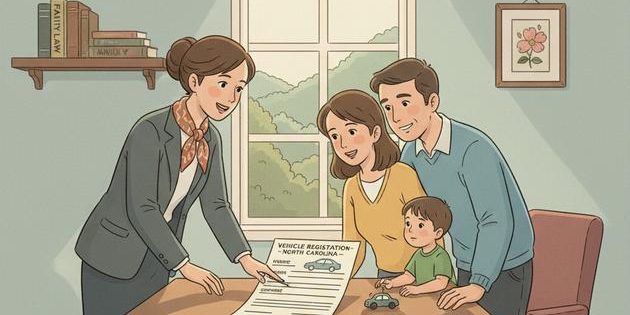
What does the court require to show my spouse owned the vehicle? – North Carolina
Short Answer
In North Carolina, courts commonly accept a vehicle document that shows the registered owner’s name and identifies the vehicle (VIN), such as a copy of the certificate of title, a DMV record, or a registration card showing the spouse as the owner. If the title cannot be obtained, a registration card copy in the spouse’s name (or a certified DMV ownership record) is often used as proof because North Carolina law treats certain certified DMV records as prima facie evidence of ownership. The court filing rules may also require the document to be scanned clearly and, in some situations, certified.
Understanding the Problem
In a North Carolina family law case, what does the court require to show that a spouse owned a specific vehicle at the relevant time? This question usually comes up when a filing needs proof that the parties were married and that a particular car belonged to one spouse, but the document that most clearly shows ownership (the title) cannot be obtained. The practical issue is identifying which “vehicle document” will satisfy the court’s request when a government office will not issue a duplicate title to the non-titled spouse.
Apply the Law
North Carolina law treats the name shown on official DMV ownership records (and certain certified copies of those records) as legally meaningful evidence of vehicle ownership. A certificate of title is the clearest ownership document because it lists all owners and any liens. But when a title copy is not available, a registration card (or a certified DMV record showing the plate/VIN is assigned to the spouse) can be used to prove ownership, especially when the statute says those certified DMV records are prima facie evidence of ownership.
Key Requirements
- Owner name matches the spouse: The document should display the spouse’s name as the owner (or registered owner) of the vehicle.
- Vehicle is clearly identified: The document should include identifiers such as the VIN and/or license plate number so the court can tie the document to the correct vehicle.
- Document is an official record (and readable): Courts generally prefer an official DMV-issued record (often certified if contested) and a clear scan that shows the key information without cutoff or blur.
What the Statutes Say
- N.C. Gen. Stat. § 8-37 (DMV ownership records as evidence) – In cases where vehicle ownership matters, certain certified DMV records (including certified title records on file) are prima facie evidence of ownership.
- N.C. Gen. Stat. § 20-57 (Title and registration card contents) – The registration card and title list the owner name and vehicle description; the title also lists all owners and liens.
- N.C. Gen. Stat. § 20-68 (Duplicate title rules) – A duplicate title generally must be requested by the owner listed on DMV records (or certain lienholders/legal representatives), which can limit access for the non-titled spouse.
Analysis
Apply the Rule to the Facts: The filing requires scanned copies of a marriage certificate and a vehicle document. The titled spouse is the owner, but the agency will not issue a duplicate title to the non-titled spouse. A registration document showing the spouse’s name and identifying details (like VIN/plate) can help satisfy the “ownership” requirement because North Carolina law recognizes certain DMV ownership records as evidence of ownership, especially when certified.
Process & Timing
- Who files: The party making the court filing in the family law case. Where: North Carolina District Court (Civil) in the county where the case is pending, filed with the Clerk of Superior Court. What: A clear scan/PDF of the marriage certificate and a vehicle record showing the spouse as owner (often a registration card copy, or a certified DMV record if needed). When: By the deadline stated in the court’s notice/order or the e-filing portal instructions for that specific filing.
- Get the best available DMV record: If the title is unavailable, obtain a current registration card copy (showing the spouse’s name) and make sure the VIN/plate is visible; if ownership is likely to be disputed, request a certified DMV ownership record that ties the plate/VIN to the spouse.
- Submit a clean, complete scan: Upload the document so the owner name, VIN/plate, and issue dates (if shown) are readable. If the court later questions authenticity, be prepared to provide the certified version or request that the court allow a certified DMV record under the applicable evidence rules.
Exceptions & Pitfalls
- Registration vs. title differences: A registration card often shows the owner’s name and vehicle description, but it may not show all owners or lien information the way a title does. If liens or co-owners matter, a certified title record from DMV may be more persuasive.
- Certification issues: Some courts accept a non-certified scan for initial filing but may require certification if another party challenges it. A certified DMV record can reduce that fight.
- Illegible scans: Cutoff VINs, blurry photos, or missing pages are common reasons a clerk or judge rejects a document as insufficient proof.
- Access limits for duplicates: North Carolina’s duplicate-title process generally limits who can request a duplicate (often the titled owner or legal representative). If the spouse will not cooperate, a DMV ownership record tied to the VIN/plate may be the practical alternative.
Conclusion
In North Carolina, the court typically looks for an official vehicle record showing the spouse’s name as the owner and clearly identifying the vehicle by VIN or plate. A title is best, but if a duplicate title cannot be obtained, a registration card copy in the spouse’s name or a certified DMV ownership record can still support ownership, and certified DMV records can carry added legal weight. Next step: file a clear scan of the registration (or certified DMV record) with the Clerk of Superior Court by the deadline in the court’s notice or order.
Talk to a Family Law Attorney
If a court filing requires proof that a spouse owned a vehicle but the title cannot be obtained, an attorney can help identify the right DMV record to request and present it in a form the court will accept. Call today at (919) 341-7055.
Disclaimer: This article provides general information about North Carolina law based on the single question stated above. It is not legal advice for your specific situation and does not create an attorney-client relationship. Laws, procedures, and local practice can change and may vary by county. If you have a deadline, act promptly and speak with a licensed North Carolina attorney.

