
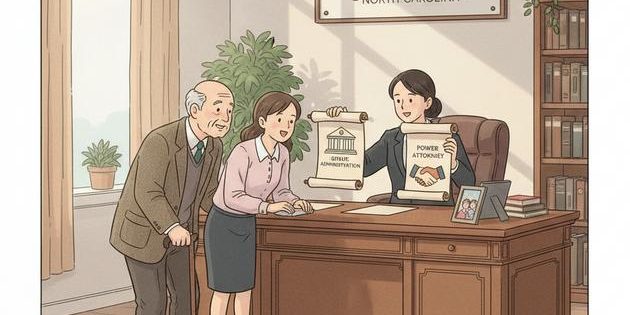
What’s the difference between administering the estate versus using a power of attorney to handle the property sale? – North Carolina
Short Answer
In North Carolina, estate administration and a power of attorney (POA) solve different problems. Estate administration is a court-supervised process in the Clerk of Superior Court where a personal representative is appointed to gather the decedent’s assets, deal with creditors, and distribute what remains. A POA only lets an agent sign and act for a living person (such as the surviving spouse) and does not replace probate or give authority over assets that belong to the decedent’s estate.
Understanding the Problem
Under North Carolina probate law, the main decision is whether the authority needed for a property sale comes from (1) a personal representative appointment to administer the decedent’s estate, or (2) a power of attorney so someone can sign for the surviving spouse while the spouse is alive but cannot appear in person. The answer depends on who legally owns the property being sold at the time of sale and whether the sale must also address estate debts and claims.
Apply the Law
North Carolina treats probate administration as a process for handling the decedent’s property and debts through a court-appointed fiduciary (an administrator when there is no will). A power of attorney is a private document that allows an agent to act for a living principal (here, the surviving spouse) and usually helps with signing closing documents, dealing with banks, and similar tasks. A POA does not give authority to act for the decedent, and it does not by itself cut off creditor claims against an estate. When real estate is involved soon after death, North Carolina has creditor-protection rules that can make a clean sale easier when a personal representative qualifies and publishes notice to creditors.
Key Requirements
- Whose authority is needed: Estate administration covers the decedent’s assets; a POA covers only the living spouse’s actions and property interests.
- Creditor handling: Probate administration is designed to identify, prioritize, and pay valid estate debts; a POA does not create the probate creditor-claim process.
- Real estate sale mechanics: If the sale involves estate real property or is happening within the period when estate creditors may assert claims against real property, title companies often require a personal representative to join in the conveyance or a court-approved sale procedure, depending on how title is held and whether the estate needs the sale proceeds to pay debts.
What the Statutes Say
- N.C. Gen. Stat. § 45-8 (Survivorship among donees of power of sale) – Shows how a “power of sale” can survive among multiple holders in a mortgage/deed of trust context (a different concept than a POA), highlighting that real estate powers depend on the specific legal instrument and role.
- N.C. Gen. Stat. § 1-339.32 (Public sale; reporting by administrators and others) – Addresses reporting rules tied to certain judicial sales, reflecting that some real-property sales by fiduciaries run through court procedures.
Note: Several key probate rules that often control estate administration, creditor notice, and sales of estate real property appear in Chapter 28A, but the controlling section numbers depend on the exact issue (for example, whether the property is part of the probate estate, whether a personal representative has a power of sale, and whether the sale is to pay debts).
Analysis
Apply the Rule to the Facts: The surviving spouse is mentally capable but physically cannot sign in person, so a POA could be useful to let an agent sign documents for the spouse at a closing. But the child’s goal also includes settling the decedent’s debts, confirming old judgments, and reimbursing funeral expenses, which are classic probate-administration tasks handled by a court-appointed administrator. Because the house is described as jointly held, the critical title question is whether the decedent’s interest passed automatically at death (which may mean the estate does not “own” the house) or whether some portion remains in the probate estate (which may require estate authority to sell).
Process & Timing
- Who files: A qualified interested person (often the surviving spouse or an heir) seeks appointment. Where: The Clerk of Superior Court (Estates Division) in the North Carolina county where the decedent resided at death (or where property is located if needed). What: An application to open an estate and qualify an administrator (AOC estate forms are commonly used by clerks). When: As soon as practical after death, especially if bills must be paid, accounts accessed, or real estate needs to be sold.
- Creditor step: In a regular estate administration, the personal representative typically publishes a notice to creditors, which starts a claims deadline that helps bring creditor issues (including old judgments) into a defined timeline. Practice in North Carolina often treats this step as important when real property may be sold within the period when estate creditors may assert claims against real property.
- Sale/signing step: If the spouse needs help signing closing documents, the spouse can sign a POA naming an agent. If the estate must join in the sale (for example, to satisfy title/creditor requirements or because sale proceeds are needed for estate debts), the personal representative may need to sign as fiduciary and may need Clerk involvement depending on the type of sale authority available.
Exceptions & Pitfalls
- POA ends at death: A POA can help the spouse sign, but it cannot be used to act for the decedent or to avoid probate tasks tied to the decedent’s debts and sole-name assets.
- Joint title can change the probate need (but not the debt issues): If the home passed to the spouse automatically at death (common with certain joint ownership forms), the estate may not need to convey the spouse’s title. However, estate administration may still be needed for the decedent’s sole accounts, creditor claims, and reimbursements.
- Creditor cutoff vs. “informal handling”: Handling assets without a regular administration can leave creditor issues lingering. North Carolina practice often treats the published notice to creditors and the PR’s process as the cleanest way to define and resolve claims.
- Mismatch between mortgage and deed: A mortgage in the decedent’s name while title is joint raises practical closing questions. The correct payoff, assumption/reassignment steps, and payoff sources should be coordinated so the closing does not accidentally leave an estate debt unpaid or create title problems.
- Old judgments require verification: “Decades-old” judgments may be satisfied, expired, or still enforceable depending on details. Failing to check them early can delay a sale or create last-minute payoff disputes.
Conclusion
In North Carolina, estate administration gives a court-appointed administrator authority to collect the decedent’s assets, address debts and claims, and complete required filings through the Clerk of Superior Court. A power of attorney only allows an agent to sign for the surviving spouse while the spouse is alive and does not replace probate or give authority over the decedent’s property. When the plan includes paying estate debts and selling real estate soon after death, the next step is usually to file to open the estate with the Clerk of Superior Court as early as possible.
Talk to a Probate Attorney
If a family is dealing with an intestate estate, creditor issues, and a real estate sale where a spouse cannot appear to sign, a probate attorney can help identify what must go through the Clerk of Superior Court, what can be handled with a power of attorney, and what timelines matter for closing and creditor claims. Call us today at (919) 341-7055.
Disclaimer: This article provides general information about North Carolina law based on the single question stated above. It is not legal advice for your specific situation and does not create an attorney-client relationship. Laws, procedures, and local practice can change and may vary by county. If you have a deadline, act promptly and speak with a licensed North Carolina attorney.

